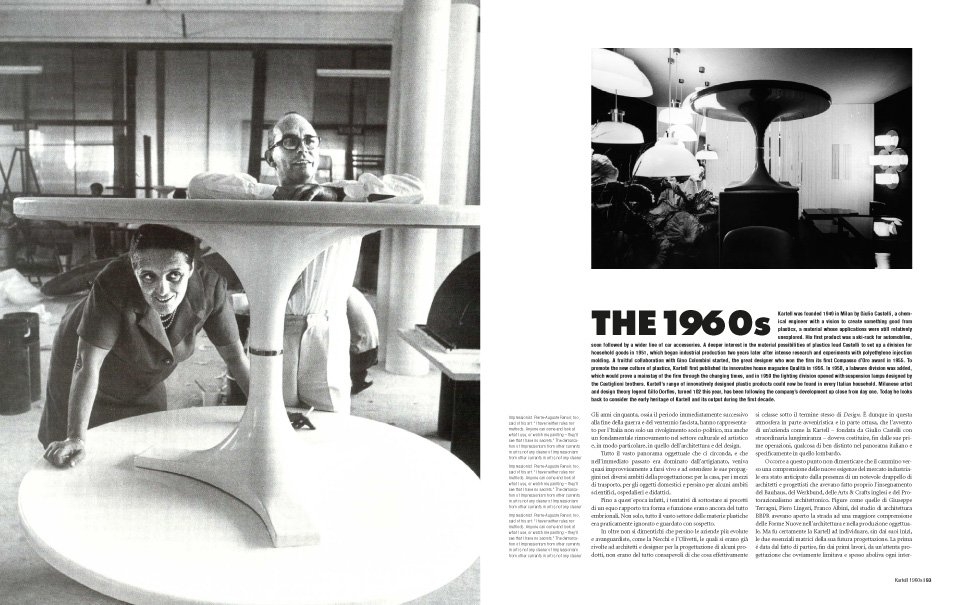
Plastic is hardly en vogue these days with young designers. But that doesn't mean that the petroleum byproduct is going away. For decades, remember, plastic was the stuff of brilliant, forward-thinking design. You might call those decades the Kartell era.
Carbon polymers were never in better hands than with the Italian company Kartell. Founded in 1949 by a chemical engineer, the company's collaboration with designer Gino Colombini ushered in an era of award-winning and useful designs. The golden age of plastic had Anna Castelli Ferrieri and Joe Colombo designing for Kartell. More recently, the Starck Ghost Chair has revived that high level of chic utility that's the hallmark of Kartell. Taschen's latest book surveys the company's history decade-by-decade with an eye-popping array of historical shots.
YOY, the Tokyo based design firm, unveiled its latest creation at the 2013 Milan Design Festival: canvas furniture. Not to be confused with furniture that is simply just made out of canvas, this furniture is actually a piece of canvas art that can be hung. Made from a frame of wood and aluminum with an elastic fabric stretched across it, each of the pieces appear to be two-dimensional from a distance. Come closer and you’ll discover that the chairs are actually functional, somewhat three-dimensional objects that can be sat on—although we wouldn't quite describe them as furniture.


The negative space in Anna Peaker's record covers, tape packages, and posters has a more active role than expected. For her Hookworms single cover for "Too Pure" (top of the post), the isolation of each image makes the collection of objects look more like a series of important symbols instead of a narrative image. Her Risograph posters show a similar restraint, while incorporating elements of collage.
Anna Peaker lives in Leeds. Keep track of her work on Tumblr. 


As a way to welcome visitors to his much larger thesis project examining the world of elaborately decorated Indian truck art, Shantanu Suman created a series of music boxes that recreate the variety of musical horns truck drivers use in India.
The unique horns aren't just a vanity addition to vehicles. In India, nearly every truck bears a form of the message "Horn Please" to ask other drivers to extend a courtesy honk before passing. After realizing the custom led to hundreds of trucks beeping at once, drivers began to modulate horns to sound more pleasing when heard together. The result is a kind of random mobile sound installation composed of many horns of different tones.
To create the music box introduction to his project, Suman first laser cut the typography and ornamentation, then painted each box by hand. [via UnderConsideration]
Check out more of Suman's "Project Horn Please" online. Watch the trailer for his documentary of the same name and a clip of the horns in action below.


Among the eight designers awarded the 2013 AIGA Medal are Jonathan Hoefler and Tobias Frere-Jones, also known as the typography studio Hoefler & Frere-Jones. The vid looks at recent works-in-progress, cruises through H&FJ’s offices and allows the designers to explain how they got into type, why they teamed up, and how they divide up the work making new fonts for new types of content. We found it surprisingly stimulating.