Pitchfork   Festivals: Chicago | Paris

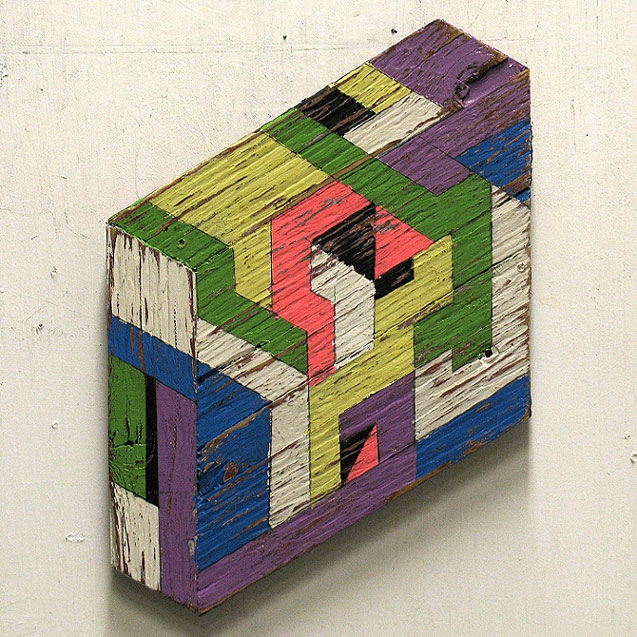
The past and future collide in the geometric sculptures of Aaron Moran. The young Canadian artist grew up east of Vancouver, BC, studied at Emily Carr University of Art + Design and Film & Video at Simon Fraser University—recently serving as artist in residence at the Ranger Station Art Gallery in Harrison Hot Springs, BC. His work balances an interest in the fine line between the natural and man-made. He works mainly with reclaimed materials—often found wood from demolition sites—in two- and three-dimensional pieces that look like some kind of future primitive pyramids. Needless to say, we're big fans so we caught up with the artist by email to find out more.

Where do you usually find the wood you work with?
It is almost entirely found from demolished houses. I scour the lots that are being demolished to make way for condos/strip malls before they take it all off to the dump. Aside from that, I just keep my eyes peeled while I'm walking or driving around - I will gladly pick stuff up and carry it back to the studio if I'm out and about.

Do you paint the pieces or are all the colors from the salvaged wood?
It's probably 50/50 - when I do paint the pieces, it is usually to contrast fragments that were found already painted.

The shapes and geometric forms you create are very modern—which artists and influences led you to work with those kinds of shapes?
Kurt Schwitters, Michael Johansen, Juan Gris, Anish Kapoor, Boris Tellegen 

What are you working on now?
I *just* finished a collection of pieces for a project with Sperry Topsider that was exhibited in Boston called "The Sea Project." This aside, I am working on a new group of  what I would call 'two and a half dimensional' works that will be exhibited in February here in the Fraser Valley.

aaronsmoran.com


More journal entries

Miranda July's upcoming "We Think Alone" project will exist only in the intimate space of the personal inbox. Over the course of 20 weeks, July will send subscribers 20 emails containing excepts from actual email correspondence from Lena Dunham, Kareem Abdul-Jabbar, Kirsten Dunst, Sheila Heti, and more. The idea of sharing emails not meant for publication came about after July noticed the surprising amount of intimacy in mundane email composition. She writes, "How they comport themselves in email is so intimate, almost obscene — a glimpse of them from their own point of view."

We Think Alone is part of a show called "On The Tip of My Tongue" commissioned by Magasin 3. Read more and sign up.

“It’s like hunting for endangered species and putting the trophy of an animal’s head in your study.” 

Meegan Czop, who works at Chicago’s Rebuilding Exchange, realizes the comparison she’s making between hunting and salvaging old buildings for raw material is a bit gruesome. But, she still gets a thrill finding a new purpose for the detritus of decades-old construction, and the hunting metaphor is apt. 

The Rebuilding Exchange has made a name for itself upcycling material for architects and designers—wood from a South Side bowling alley was used to build the offices of Trunk Club, the online bespoke fashion powerhouse, for example. And the RX recently collaborated with Strand Design to create stylish benches and clocks from reclaimed material. But the company’s current project, helping find a home for wood from the Old Globe Grain Elevator in Superior, Wisconsin, may be its biggest job yet. The eight-story mill, completed in 1887, is one of the largest in North America and could provide over five million board feet of lumber—“enough to rebuild Wrigley Field"—to designers. The wood is all old-growth timber that’s been smoothed out into intricate, wavy patterns by decades of erosion from falling grain. The RX crew is racing to get as much material as they can before the bank forecloses on the land, and have already found architects and designers interested in utilizing this rare cache of wood.

“People should have the same appreciation for this material as they have for finding old vinyl,” says Czop. “It can be dangerous working up there, wielding a chainsaw on a boom, but this is a salvager’s dream come true.   

Put in an order for your old growth grain elevator wood at Rebuildingexchange.org


http://noma-cdn.s3.amazonaws.com/content/mill.jpg

Photo by: Boing Boing

There's no shortage of amazing facts about Brian Eno. And, no, we're not talking about the album he did with Television. It is only natural that the musical pioneer might enjoy a good feline cuddle once in a while like the rest of us. The Internet blogs would have us believe he once did a Purina ad, with his own cat, no less. But the original posting at Dangerous Minds seems to have gone offline, and while Boing Boing has a link to a large version, the image shows no trace of a moire pattern which would indicate it had been scanned from an old magazine. That's not a dealbreaker, of course, as moire patterns are easily removed by Photoshop experts, but it is slightly suspicious. We remain skeptical but intrigued.

Video by Score. Music by Boyton.

Curator and artist SuperBlast traveled the States from coast to coast to meet Cleon Peterson, Cody Hudson, and Martha Cooper—all artists represented in the upcoming "FUTURE/MEMORY" show opening June 22 in Dresden, Germany. Hudson talks about the relationship between his sculpture and painting—and his art as a means of expression. Peterson explains his attraction to dark subject matter. Also on the show flyer are Boogie, Horfeé, Husk Mit Navn, Stefan Marx, Cleon Peterson, Jay "One" Ramier, Skki, and SuperBlast himself. The show is for the Street Culture @ Hellerau, a festival at the European Center for the Arts Dresden.

FUTURE/MEMORY runs June 22—July 6, 2013, 4pm-8pm, free.