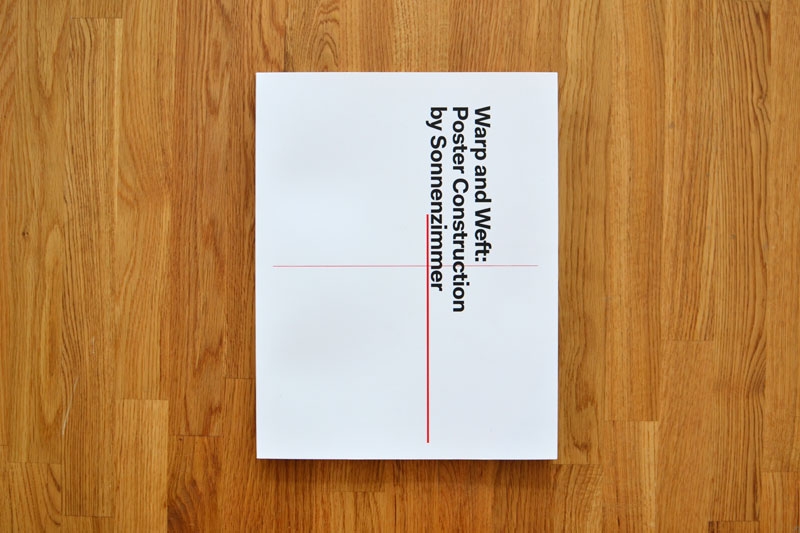
This Sunday, Brooklyn's Beginnings (110 Meserole Ave) hosts a book release for Warp and Weft: Poster Construction by Sonnenzimmer as well as a pop-up shop.
Curious about the new book on poster construction, we asked Chicago designer Zach Dodson (who co-edited the book with featherproof books cohort Jonathan Messinger) what he learned working on the project with "Wabi-Sabi design masters" Sonnenzimmer, AKA Chicago-based studio of Nick Butcher and Nadine Nakanishi. Here's what he told us.
1. How to approach things (and people) thoughtfully. Wabi-Sabi principles: Simplicity and Modesty
Anyone can stumble onto a good design. But how to achieve amazing results consistently? The answer: Process. Long, thoughtful, intentional process. And when it comes to process, the Chicago art and design studio Sonnenzimmer have got it down pat.
When they tapped Jonathan Messinger and I at the small press we run, featherproof books, to lend a hand editing their first ever full length book, we jumped at the chance to take a peak inside their process, and be part of the fun. Also, they were so kind and humble and funny in their approach, how could we say no? They acted thankful that we were working with them every step of the way, though we should have really been then thankful ones. This is a great approach to collaboration.
And the results are amazing. Sonnenzimmer has got a style all its own.
2. How to pay attention to the hiccups, go with the flow, and be patient. Wabi-Sabi principles: Imperfection and Acceptance
What's the Sonnenzimmer process like? In the limb-bound, foil-stamped Warp and Weft, they get down and dirty with some of their best posters, analyzing each in terms of pop culture, art history, and formal composition. If anyone knows how to take advantage of the ‘happy accident’ it’s Sonnenzimmer. The compositional reads are broken out into schematics to show you how each poster is meant to be read, graphically. He's responsible for the stunning look and feel of the entire book. There were hiccups editing and due to some crazy life circumstances I fell off the grid for a few weeks while Jonathan picked up the slack. The road was bumpy at times but without the struggle the book would be completely different.
The book (designed by by Alex Fuller of the hippie cult Post Family) provides a fascinating peak inside Sonnenzimmer's thoughtful poster-making process. They brought the same level of care and attention to the process of creating a book. Typically, we met at their space, they asked questions and debated (sometimes with us, sometimes with each other) every aspect of the book, and how it could get across what it was like to work inside their small art and design studio. We were on a schedule, and passed many rounds of revisions back and forth, pruning, editing, expanding, smoothing the edges, and tightening down the hatches until the book as a whole was a perfectly balanced, well-executed piece of art.
Just like their posters! Some of which subscribe to the Japanese principles of Wabi-Sabi.
3. Just what the hell Wabi-Sabi is.
A mystical, nostalgic Japanese philosophy of beauty, focused around the imperfections created by nature, aging, and accident. It’s the scar on the otherwise perfect face, the stains on a teapot from years of use, and the faded, cracking autumn leaves. You wanna see that philosophy exercised in the wild world of rock posters? Then you should buy and study your own copy of Warp and Weft.
Warp and Weft: Poster Construction by Sonnenzimmer
Book Release and Pop-up Shop
Sunday, Feb 24, 11–4pm
Beginnings
110 Meserole Ave
Brooklyn, NY 11222