Pitchfork   Festivals: Chicago | Paris

For those looking for a little defense from the sun’s mighty rays during the warmer months, cool shades are a must. Even under the gloomier skies of winter, sunglasses remain essential—that diffuse light can sneak up on you. But luxury sunglasses have also become associated with free-for-all spending, and lousy retail mark-ups.

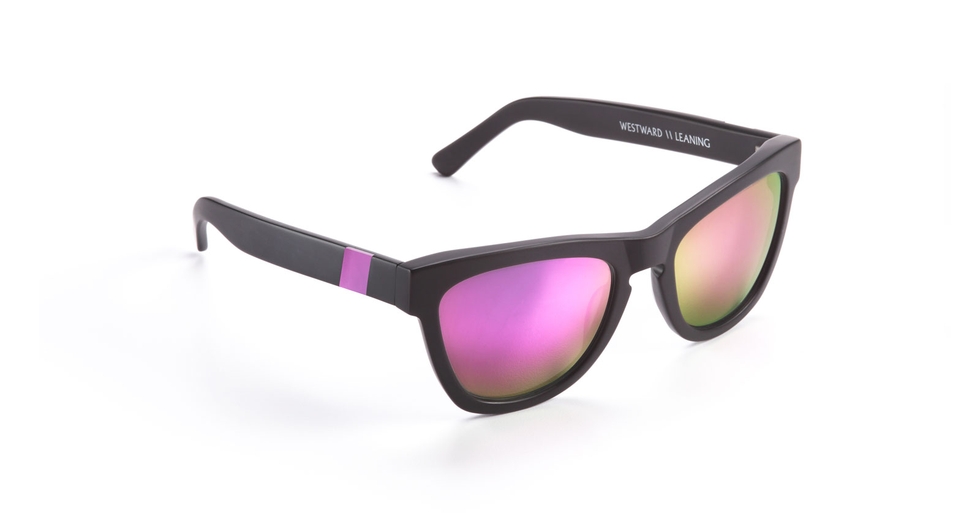
So when Robert Denning and Karlygash Burkitbayeva, who met as students at Stanford Business School, realized their shared interest in social progress and their mutual love for fashionable eyewear, they began conceptualizing ways that retail could engage with contemporary social issues. With backgrounds in business, design, and culture, the pair teamed up to create Westward Leaning, a luxury—yet socially responsible—collection of sunglasses featuring one universally flattering shape based off of the classic Wayfarer design.

Available in nine models, each pair features a unique material in honor of a person, place, or organization that has contributed to social progress. The Teddy Roosevelt model features material from naturally-shed antlers collected by Boy Scouts at the National Elk Refuge. The Children of California model celebrates the Golden State and its achievements with reclaimed Californian redwood. And for every pair of sunglasses sold, Westward Leaning donates ten dollars to education programs related to the specific achievements its sunglasses celebrate. With an obvious focus on celebrating the triumphs of humanity and sending a message of hopefulness into the world, Westward Leaning believes investing in a pair of these shades won’t feel entirely self-indulgent. 

More journal entries

Kirra Jamison's modern paintings might seem a bit random, like cast-offs from a Matisse cut-out broken up, but they're actually created through a more intricate, inspired process. Jamison began with scraps of vinyl on the floor of her studio, arranged them into abstract collages and then screenprinted over them for the series "Total Control." For "Locomotor," she took the smaller prints and recreated them in acrylic. The effect is strangely pleasing to the eye even if it isn't even obvious that her creations are drawing from the material world.


"Tenon Cargo"
"Mortise"

"Hum 2012"
"Arch" from "Total Control"

It takes approximately 200 trucks worth of dirt to build a two-acre field of wheat in lower Manhattan. And if farmed correctly, those two acres can grow about 1,000 pounds of healthy, edible wheat.

Those figures are not an estimate. In 1982, directly adjacent to the World Trade Center, artist Agnes Denes planted and farmed two acres of golden wheat as part of an installation called "Wheatfield - A Confrontation: Battery Park Landfill, Downtown Manhattan." The confrontation she describes isn't limited to the visual strangeness of seeing a farmer ride a tractor in front of a city skyline. Instead, the project also speaks to the confrontation of farming wheat on land valued at $4.5 billion, and bigger issues of mismanagement leading to world hunger and food waste. 

After the harvest, Denes took the grain to 28 cities and distributed the seeds for planting in a number of countries.

Photos from Confrontation are on exhibit at MoMa's Ps1 in Queens as part of their #Expo1 series.


And That cuff

Veering away from the highly embellished pieces that have been shown the past few seasons, SS2013's metal jewelry trend opts for boldness of shape and suggests an understated sophistication. Designers such as Pamela Love, Bliss Lau, and Balenciaga combine the sleekness of metal with interesting geometrical qualities, tribal influences, and cut-outs. Gold, silver, rose-gold are all fair game in this future primitive style and make an excellent companion to any warm weather ensemble.


Jill Golden necklace, $276


Balenciaga rings

Pamela Love cuff, $400

Bliss Lau body chain, $215


Not long after announcing a switch to a subscription cloud-based model for its ever-popular Creative Suite, Adobe steps into the hardware market with the "Project Mighty" stylus and "Napoleon" ruler. The devices are designed to work together, using Bluetooth and an upcoming Adobe app, to mimic the experience of sketching with a pen on paper. From a tactile perspective, the stylus features a pressurized tip to make line drawing feel more natural. Conceptually, the devices are built for collaboration, and have sharing functions built-in to move assets to and from the cloud and whatever tablet you're working on. When we get our hands on them, we'll let you know. [via Design Taxi]