Pitchfork   Festivals: Chicago | Paris

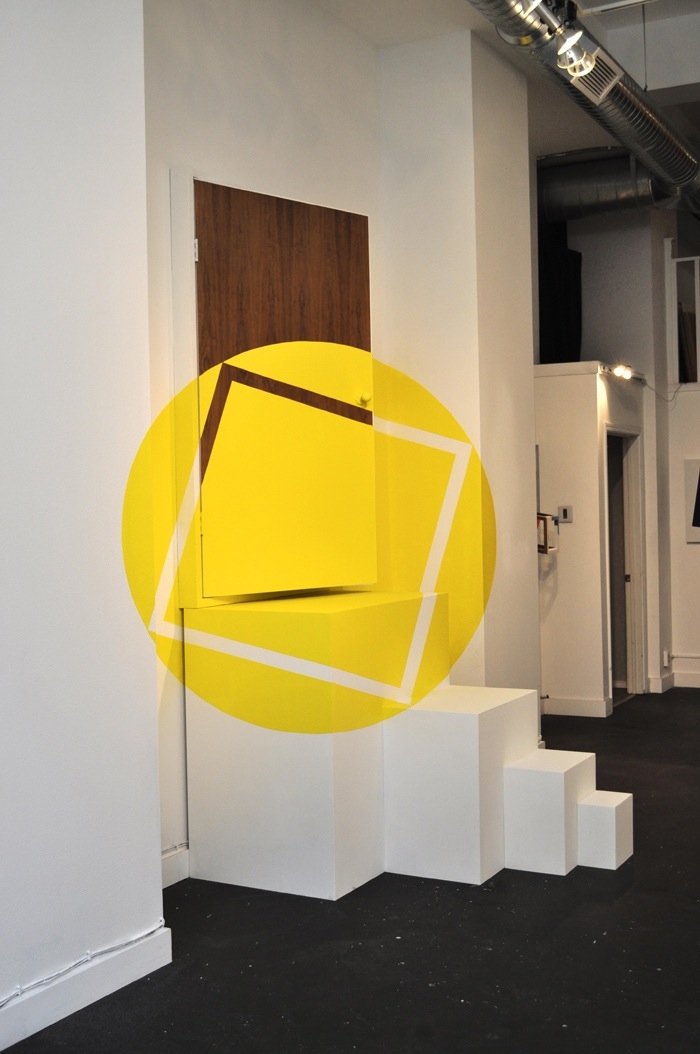
Christopher Derek Bruno wants you to think about relationships. His paintings force you to consider at least two. The first is a physical one, and it’s between the viewer and the painting. He builds three-dimensional shapes to manipulate the image the viewer sees depending on where they are standing in relation to the painting in a gallery. He considers the slow walk we all do at shows, and allows the three-dimensional structures to manipulate his painted forms as we leave a work.

The second relationship is between the enamel colors he paints onto those three-dimensional forms. He uses very transparent colors, and layers geometric shapes to achieve a similar effect to overprinting, most commonly seen in silkscreen printed work. We think his work is meant to be seen in motion [via booooom].

0 art
More journal entries

To celebrate the 150th anniversary of the London Underground, Penguin UK has published a series of paperbacks related to various stops on the venerable Tube. While we're considering taking home a stack on our next trip to the Big Smoke, there's one in particular that caught our eye right away. Fantastic Man's Buttoned-Up devles into the question of why East London men tend to button their shirts all the way up. It features Neil Tennant of the Pet Shop Boys and other notorious buttoners from the East End pondering the question.

Buttoned-Up is available via Penguin in the UK.

If you're not a fan of Fantastic Man yet, you should take a stroll around the fashion mag's site and check-out its recommendations.

YOY, the Tokyo based design firm, unveiled its latest creation at the 2013 Milan Design Festival: canvas furniture. Not to be confused with furniture that is simply just made out of canvas, this furniture is actually a piece of canvas art that can be hung. Made from a frame of wood and aluminum with an elastic fabric stretched across it, each of the pieces appear to be two-dimensional from a distance. Come closer and you’ll discover that the chairs are actually functional, somewhat three-dimensional objects that can be sat on—although we wouldn't quite describe them as furniture.


The negative space in Anna Peaker's record covers, tape packages, and posters has a more active role than expected. For her Hookworms single cover for "Too Pure" (top of the post), the isolation of each image makes the collection of objects look more like a series of important symbols instead of a narrative image. Her Risograph posters show a similar restraint, while incorporating elements of collage.

Anna Peaker lives in Leeds. Keep track of her work on Tumblr. 


As a way to welcome visitors to his much larger thesis project examining the world of elaborately decorated Indian truck art, Shantanu Suman created a series of music boxes that recreate the variety of musical horns truck drivers use in India. 

The unique horns aren't just a vanity addition to vehicles. In India, nearly every truck bears a form of the message "Horn Please" to ask other drivers to extend a courtesy honk before passing. After realizing the custom led to hundreds of trucks beeping at once, drivers began to modulate horns to sound more pleasing when heard together. The result is a kind of random mobile sound installation composed of many horns of different tones.

To create the music box introduction to his project, Suman first laser cut the typography and ornamentation, then painted each box by hand. [via UnderConsideration]

Check out more of Suman's "Project Horn Please" online. Watch the trailer for his documentary of the same name and a clip of the horns in action below.