Pitchfork   Festivals: Chicago | Paris

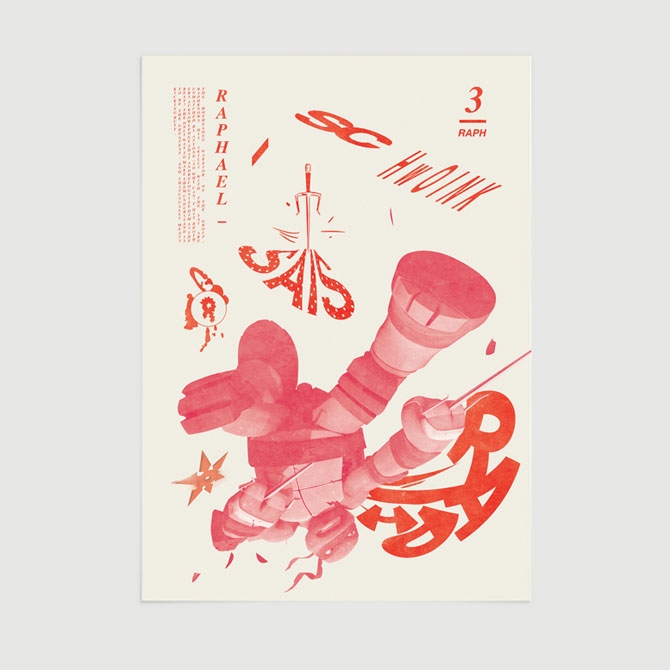
When he's not perfecting the look of SpongeBob or the Teenage Mutant Ninja Turtles for Nickelodeon, Michael Robert Boswell does some great work on his own. Boswell's portfolio is split between fine arts work and graphic design projects, and we get the feeling that, for Boswell, those worlds aren't mutually exclusive.

To appreciate Boswell's work there's really no need to distinguish between the two. His site boasts an impressive selection of skateboards, branding work, posters, sweatshirts, artist books, prints, and sculptures that form a more or less cohesive group.

Boswell's posters are a great example of the playful experimental nature of much of his work. He approaches his posters with methods outside of traditional printmaking. He's used a laser cutter to make piece interact with a gallery's lighting and laminated prints from an inkjet printer with sticky notes for a hip-hop gig poster.

He's a bit of a prankster, too. At a recent show, he rested his prints on what look to be bars of solid gold.

More journal entries

The xx and Grizzly Bear toured the U.S. and Canada together and Manchester's Dr. Me designed a very handsome poster available only at the shows. Some superfans couldn't make the gigs, however, and petitioned for their own posters. So the designer has wisely made the posters available to the rest of us.

Stalk desktop speakers are actually designed to stand next to a crowded desk, rather than take up valuable desktop real estate. The two models (taller or shorter) are built with colored steel legs and a 3D-printed dome, both meant to be chosen by the owner to personalize the set. The designer, New Zealand-based Ella Bates-Hermans, developed the cone patterns by experimenting with 3D printing textures, and drew inspiration for the speaker's form by studying the shape of speaker drivers. [via NOTCOT]

Check out the Stalk speakers on Behance.


At one point in time, we took them for granted. Payphones were a must—if you were running late, lost, or traveling and needed to make reservations—or perhaps didn't have a home phone. The eventual affordability and popularity of mobile phones wiped them out, destroying the market for their use and making payphones, it seems, not worth the time or money to maintain. Some still exist, sometimes in the oddest of places, and we're sure that some of us still need them in a pinch. By now, their increasing rarity makes them ripe as a photographic subject. #payphoneography is a bit like a chronicle of the last days of a connected, cheap public communication network—with the occassional shot of an exotic callbox from a far-flung locale. Particularly sad, we think, are the "carcasses" of ripped-out phones.

As part of an exhibit at this year's Design/Miami Basel fair celebrating Swiss design and promoting tourism, seven designers were given discarded gondolas from the Verbier resort in the Swiss Alps and told to use the materials to create new work. Some kept the basic form of the gondolas and created rocking benches and tables, while others deconstructed the cars entirely, creating new installations that only vaguely suggested the shape of the classic gondola. The seven designs will be shown during a brief tour of Switzerland, and auctioned by Christie's to raise funds for the Make-a-Wish foundation. [via Yatzer / photos © Annik Wetter]